Samantha Stainburn

Writer | Editor

Posts from the ‘College’ category

The Sophomore Slump

(The New York Times, 01 November 2013)

Pity the sophomore. You are feted as a freshman, but no one seems to care that you’re back on campus. Quirky first-year seminars have been replaced by large foundation classes, making you doubt that major in econ or bio. You’re not high enough up the totem pole to do fun stuff like join a research team or lead student organizations. With the newness of college gone, malaise sets in.

The “sophomore slump” helps explain the findings of a 2012 report by the Education Advisory Board — that 6 percent of students at state flagship campuses leave in their second year. It may also explain why a quarter of sophomores in a 2012 survey by the consulting firm Noel-Levitz reported not being energized by their classes or feeling at home on their campus.

Dissatisfaction with how college is going is in itself not a bad thing, says David Shein, dean of studies at Bard College. “Whether it comes off as a slump depends on how you handle it.”

GET WITH THE PROGRAM

Some colleges are trying to make sophomores feel less like overlooked middle children. This year, Ohio State University is piloting a program to increase sophomore-faculty interaction. One thousand sophomores are living in dorms visited regularly by faculty mentors, who help them set goals and plan an educational experience like studying abroad or interning, for which $2,000 stipends are available.

Purdue University recently announced its fourth sophomore-only “learning community.” Starting next fall, 20 second-year students interested in statistics will live together, take classes together and work on a full-year research project, and earn a $9,400 stipend. (The other communities focus on leadership and science and technology research.) “Sophomores struggle with academic engagement, and a learning community allows a student to explore a topic out of the classroom with faculty members,” says Jared Tippets, Purdue’s director of Student Success.

STUDY AROUND

Big decisions loom sophomore year: what are you going to major in and, by extension, do with your life? Angst about committing to one path, and rejecting others, can cast a pall over the second year.

“We enter college with all of these dreams about what we’re going to be, and we have to put some of those to rest in the second year,” says Molly A. Schaller, a University of Dayton professor who studies the second-year slump. “Even if it was Mom and Dad’s dream, it feels like a loss.”

Often, struggling with a second-year course indicates that a career in the subject is not meant to be. But not always. Dr. Shein of Bard poses the question: “Are you struggling because you like the material but you’re having difficulty with some of the components, or are you not engaged with it?”

If it’s the former, tutoring in your weak skills could get you back on track. If you’re bored with what you’re studying, Dr. Schaller says, “redouble your efforts to figure out where you fit in.” Meet with professors, try different classes, get involved with new clubs.

Above all, she says, don’t settle for a major because you haven’t explored enough to find what you really like.

CHANGE UP FRIENDS

Not everyone falls in with lifelong friends as a freshman, but in the strange social universe of college, it’s socially taboo to jettison students you hung out with in the first year.

That doesn’t mean you’re stuck with people you don’t click with, says Andrew Wilson, senior associate dean for external relations in the office of campus life at Emory University.

While a confrontational end to relationships isn’t acceptable, Dr. Wilson says, “friendships can also dissolve in a nebulous, unstructured way. It’s fairly easy to fade away from people if you aren’t feeling connected to them. Blame your schedule.”

Dr. Wilson should know about such things. For many years he oversaw the Second Year at Emory program, which places advisers in residence halls and organizes dinners with faculty members and workshops on goal-setting for sophomores. And the focus of his research: college friendships.

Read this article at the New York Times.

Who Owns Your Great Idea?

(The New York Times, 04 January 2009) 

Matthew Naples (L) and Peter Zummo.

Matthew Naples (L) and Peter Zummo.

Peter Zummo, a senior double-majoring in design and mechanical engineering at Rensselaer Polytechnic Institute, is used to explaining the products he thinks up for his studio-class assignments. But last spring, he found himself answering questions of a different kind in a conference room at Rensselaer’s office of technology commercialization, which tracks and patents inventions made on campus.

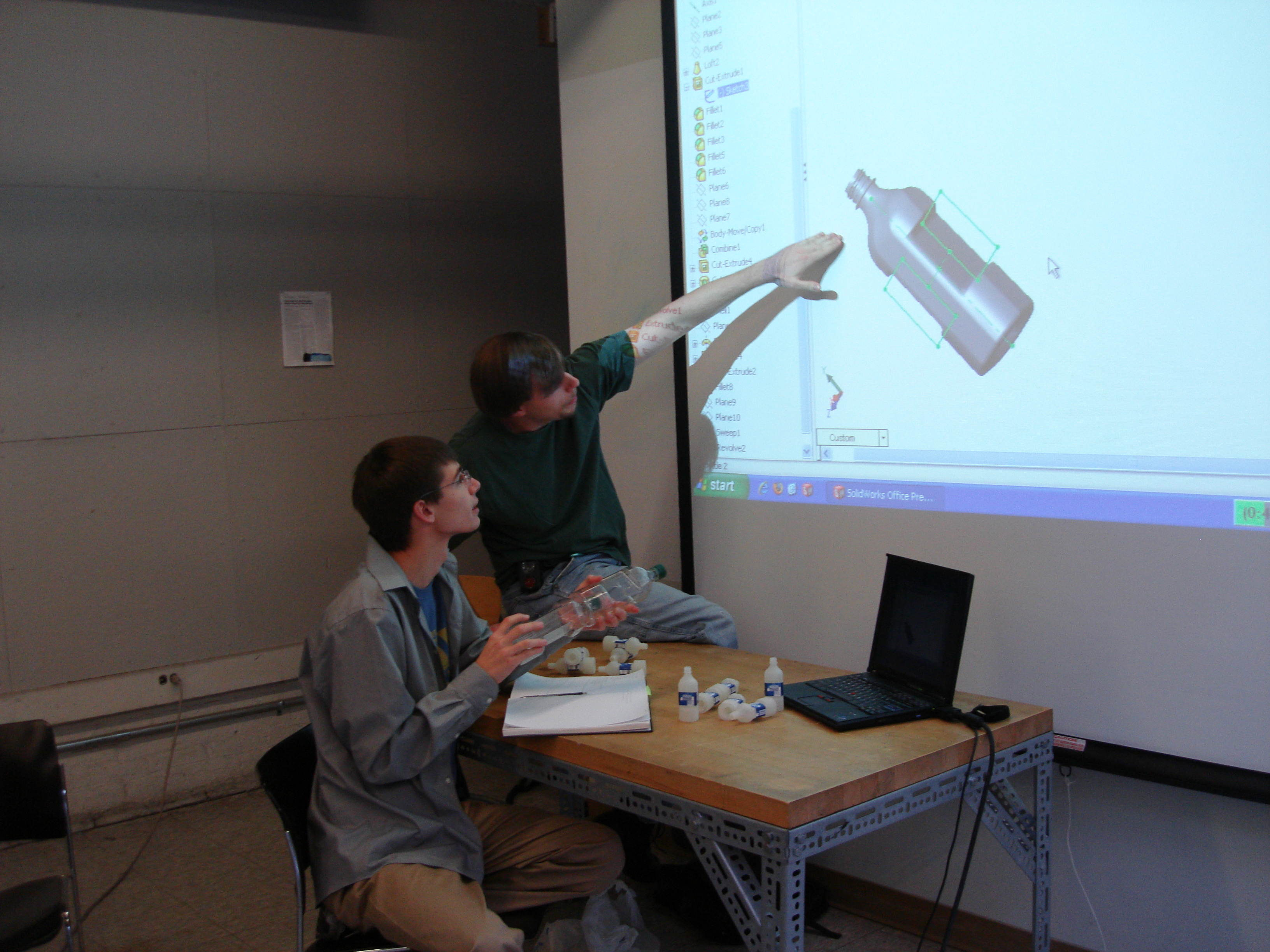
Mr. Zummo and his classmate Matthew Naples, who was attending the meeting via speakerphone, had designed a water bottle that could be filled with sand and reused as a brick to build housing in developing countries. The director of the office, Charles Rancourt, sitting across the table from Mr. Zummo, wanted to know: When had they come up with their design? Had they held brainstorming sessions on campus or off? What equipment had they used to produce their prototypes?

Colleges and universities own the ideas and technologies invented by the people who work for them, including professors and graduate students who are paid to do research. Most universities also own inventions created by students using a significant amount of their resources, even if the inventors are undergraduates like Mr. Zummo and Mr. Naples, both 21.

The question of whether the two students or R.P.I. owned their invention was a tricky one. They had first designed plastic bottles that snapped together, Lego style, with two other students for a freshman design class project that challenged them to solve a social problem. Their idea was to keep the billions of water bottles that people in developing nations throw away each year out of landfills while providing the poor with free building materials. They presented a paper and a prototype in class, but “it was a crude concept, and we never really hit our goals with our first rendition,” Mr. Naples says.

As juniors, he and Mr. Zummo decided to tinker with the design again on their own (the rest of the original group didn’t want to join them), brainstorming off the Troy, N.Y., campus and interviewing bottle manufacturers about the molding process and materials. They developed a new design that was cheaper to manufacture and could withstand more types of stresses than the first.

With entrepreneurship booming, especially in courses that mix M.B.A. candidates with budding physicians or engineers, more and younger students are coming up with ideas that have commercial potential. While formal programs offer classes in managing intellectual property, plenty of students develop their ideas with little knowledge of how ownership is determined or the pros and cons of involving the university.

“Universities want to get whatever revenue streams come out of inventions so they can build more labs, have more research going on and hire more professors,” says David Schwartz, executive editor of Technology Transfer Tactics, a newsletter for people working in the field. Lisa Rooney, director of Ohio University’s tech transfer office, notes another interest: “Most universities have a broader economic mission to help out their communities and states, and licensing or starting new companies is a way to do that.”

Colleges and universities obtained fewer than 250 patents a year before 1980, when the Bayh-Dole Act gave them ownership of inventions developed through federally financed research. Now they acquire about 3,000 a year, according to the Association of University Technology Managers, whose members work in tech transfer offices. In 2006, association members made $45 billion from licensing fees and equity in spinoff companies; research powerhouses like Stanford and New York University made $61 million and $157 million, respectively.

University help can be a boon for student inventors, too. A third to half of the money generated by a product is typically assigned to the student, with the rest split between the student’s department and the university. That’s a better deal than the zero percent collected by scientists working for corporations. And universities cover the legal fees involved in obtaining patents on inventions they own, which can easily total $15,000 a patent.

“You can imagine a 20-year-old who develops something isn’t going to have access to venture capital money or the expertise to patent it,” Mr. Schwartz says. “The tech transfer office can find the resources to move it forward.”

Of course, the offices negotiate deals that are best for the university, notes Peter Corless, a partner at the law firm Edwards Angell Palmer & Dodge in Boston. He specializes in protecting biotech and medical device inventions at academic institutions. “If they can, they’re going to give some deference to the inventor, but their first allegiance is to do something for the university,” he says.

Erez Lieberman, a 28-year-old graduate student doing federally financed research at the Harvard-M.I.T. division of health sciences and technology, discovered this tendency after the Massachusetts Institute of Technology pushed through a patent on a technology he created as an intern at NASA in the summer of 2007. His algorithm detects whether a person is standing correctly or is off balance, and Mr. Lieberman, currently in the sixth year of his Ph.D. program, has started a company called iShoe to develop products using the technology, including insoles that can help prevent elderly people from falling. Because M.I.T. is co-owner of the invention with Harvard and NASA, Mr. Lieberman knew he would have to negotiate a licensing agreement that would give his company exclusive rights to the technology, but he was taken aback by M.I.T.’s tough negotiating stance.

“I wasn’t aware of the fact that more or less the day after the patent was filed, I would be facing a conversation like, ‘We take a substantial royalty and $75,000 now, and it’s all yours,’ ” he says. “That was a surprise.”

Jack Turner, associate director of M.I.T.’s tech licensing office, says: “We endeavor to get what we think is a fair deal for M.I.T. and the inventors and for the companies we’re licensing. At the same time we don’t want to license something exclusively to someone who’s going to end up not doing anything. We write into the agreement those elements of the business plan that we consider essential for the technology to find its way into use. If they can’t do that, we can get the technology back and find another home for it.”

Ultimately, Mr. Lieberman says, the fact that M.I.T. doesn’t automatically kick the license to an inventor is for the best. “It enforces discipline on you,” he says. “The process has been valuable for us in terms of thinking hard about what needs to happen, how do we raise money and what kinds of milestones make sense.”

He’s hopeful that he can raise funds for the license through angel investors or a joint venture with a hospital. But now that he knows how expensive and complicated the licensing process is (not to mention having to check in in the future to show he’s on track), Mr. Lieberman is avoiding using university resources as he develops the technology further. Last summer he paid an engineer and a computer programmer through iShoe to work off campus to improve the design of his insole and write software that lets it communicate with wireless devices. Using $25,000 worth of legal services he won in April in a business plan competition for space-derived technologies, he has filed for two additional patents, owned by iShoe, based on their work.

If a student has money to develop and protect an invention on his own, should he? It depends. Turning the job of commercializing a product over to a university is a better bet if you have no interest in business or if finishing school is a priority. “The mission of a student is to research, get their degree, and move on with their life, and if you start fooling around with this stuff too much, it’s a total distraction,” says Peter Corless, the intellectual-property lawyer. But if retaining control over an idea is important — say, you don’t want your technology licensed to a company that pollutes oceans — the expense and hassle of doing it yourself might be worth it.

Lone-wolf inventors should get a written statement from their university confirming they own their idea, Mr. Corless advises. “You want to get these things cleared up when there hasn’t been a lot of value recognized,” he says. “If you try to clear things up later, people’s memories change.”

R.P.I. determined that the bottle design belonged to Mr. Zummo and Mr. Naples. The university offered to patent the bottles and get them into the market if they transferred ownership of the design to the university. The students chose to go it alone, deciding that the standard slice of royalties R.P.I. gives to inventors, 35 percent, was too low. An intellectual property lawyer who’s a friend of Mr. Zummo’s family waived his fees to help them file a provisional patent, and the students started looking for ways to raise $18,000 to mold several hundred actual bottles they can test and show to companies interested in licensing the technology from them.

They’re not flying entirely solo, though. Last month, the university determined that while the students own the design, R.P.I. owns the idea for the bottles. The students must license it from them, at a cost of about $250 a year and 25 percent of the profits generated by the idea. That, though, comes to only 0.5 percent — an “idea” being worth less than the “design.”

“What we’re giving up is obviously nothing, and if someone infringes on our rights, now it’s R.P.I. against them,” Mr. Naples says.

The bottle negotiations helped convince R.P.I. to rethink its royalty-sharing policies for students in studio courses: it’s now 75 percent for the inventors, 25 percent for the university. For one, the university recognizes the distinction between the ideas coming out of undergraduate design classes and those coming out of a research center or lab, Mr. Rancourt of R.P.I. says.

“Given the early stage of development, a significant amount of work needs to happen to prove the idea,” he says. “At the same time, they have real potential, and our goal is to encourage them.”

Read this article at the New York Times.

Strategy/Costs: Paying for College on Your Own

(The New York Times, 18 April 2010) 

THE REALITY

The federal government expects parents to help pay for college. But plenty of students can’t get one penny from them. “At Michigan State, we see several hundred of those students every year,” says Val Meyers, associate director of its financial aid office. Some parents don’t believe they can or should contribute, or maybe they don’t like a particular college, or aren’t living together. A father might refuse to take responsibility for the education of a child from a first marriage.

And here’s a sticky wicket: an 18- year-old may be an adult in most states, but for financial aid purposes, students aren’t independent until age 24.

HOW TO

Try everything in your power to get your custodial parent to supply financial particulars on the Free Application for Federal Student Aid.

“Filing the Fafsa does not obligate the parent to pay the bill,” says Samantha Veeder, director of financial aid at Nazareth College in Rochester, N.Y., who has sat on panels on the subject. But without a parent’s financial information a student will not be eligible for need-based institutional aid — the only kind the Ivy League offers, for example — or any federal aid other than a Stafford loan ($5,500, or $7,500 for juniors and up).

If the parent can report low income, a student could see enough aid to cover the lion’s share of college costs. If not, why go to the trouble? “You don’t know that you’re not going to qualify,” Ms. Veeder says. “You could make six figures, and if you’re applying to a $50,000 college, you’re going to qualify for some aid.”

PLAN B

Independent students have a better shot at aid. That’s because colleges determine how much to award based on the student’s wages, not a parent’s, which almost certainly would be higher.

If you can check “yes” on any of these life scenarios, and can prove it, you should apply as an independent: over age 24; supporting a dependent; married (take note, divorced students, you automatically go back under a parent’s wing); in the military or a veteran; in foster care, a ward of the court, an orphan or homeless (or at risk of being kicked off someone’s couch with nowhere else to go).

This academic year, for the first time, verifiably homeless students and emancipated minors get independent status without having to appeal. Those who might cut the cord for financial aid reasons should consider that emancipation can take a year; that a child generally has to already be self-sufficient; and that about 20 states, New York among them, don’t even allow emancipation.

IN THE END

A financial aid officer can classify you as independent if there are circumstances that make it inappropriate to expect a parent to kick in cash for college. Living apart from them or supporting yourself financially is not unusual enough.

“We’re looking for documented cases of abandonment, abuse or complete dissolution of the family,” Ms. Veeder says. “If it’s just a matter of, ‘I moved out because my mom doesn’t like my boyfriend,’ or a parent who says, ‘I don’t want to pay for a $50,000 private, but I’ll send you to a state school,’ you’re not going to get an independence override.”

Proving independent status is an arduous task, requiring police and medical reports showing abuse or evidence that parents are dead, in jail or in rehab as well as letters from teachers and friends’ parents who can corroborate your story.

Ultimately, the financial aid system is not on your side if your parents simply decide to mess with your life by not filling out the Fafsa. “It puts the student in a bad position,” Ms. Meyers says. “If parents are not willing to meet their responsibilities, there are some options. But they aren’t real good ones.”

Read this article at the New York Times.

Ratio, Schmatio

(The New York Times, 05 November 2006)

ISABELLE CARBONELL, a college senior from Bethesda, Md., has thrived over the last four years as part of a small learning community. Most of her classes have had fewer than 35 students. For freshman and sophomore years, her dormitory was in the same building as the cafeteria and many of her classrooms and professors’ offices. ”You see the same people over and over, and that lets you create networks,” she says. ”You get to know your professors informally. You see them in the hallway, they say, ‘How’s that project going along?’ and you bounce ideas off them.” Prospective undergraduates are deluged with statistics — from average class size to the number of Nobel Prize winners on staff — with which to take the measure of a college. Is Ms. Carbonell’s story an argument for choosing your college by the numbers?

Not exactly. She attends the University of Michigan at Ann Arbor, which has some 25,000 undergraduates, 4,100 full-time faculty members and 540 buildings. If she had been looking for an intimate experience, the numbers would have led her elsewhere. That’s just one of the problems with statistics: they rarely tell the whole story. (Ms. Carbonell’s story is that she signed up for Michigan’s Residential College, a program in which students live and attend classes in the same building. She now lives off campus but continues to take classes in the R.C. building.)

Another problem with numbers: ”Often statistics don’t measure what’s important,” says Lloyd Thacker, executive director of the Education Conservancy, a nonprofit group working to improve the college admissions process. For example, the selectivity of a college, measured by how many applicants it denies, provides little information about the educational experience there.

Also, statistics can be fudged. Regard any number you read in a glossy brochure or on a university Web site with skepticism, says Arthur Levine, president of the Woodrow Wilson National Fellowship Foundation. ”It’s not information,” he says. ”It’s marketing.” This fall Margaret Spellings, the secretary of education, announced a plan to push colleges to clarify and expand the data they report about themselves, including collecting information about student learning.

Until that comes to pass, though, the college- bound will just have to make do. Here are six common statistics that students in search of a quality college should parse carefully.

1. CLASS SIZE AVERAGE: DON’T BOTHER

You want most of your classes to have about 25 students, says Marty O’Connell, a spokeswoman for Colleges That Change Lives, a nonprofit organization that promotes the ideas espoused in Loren Pope’s books of the same name. ”These are settings where students can be asked to be critical, creative thinkers and to collaborate with their peers and teachers,” she says. ”Faculty members cannot get to know students if you have 300 in a room.”

But don’t depend on a college’s averageclass- size statistic to predict the density of your classroom. As an average, it distorts reality by including, say, the tiny Tagalog seminars you’ll never take with the popular politics courses you will.

The same can be said of student/faculty ratio: a campus can have a 13-to-1 ratio and you can still end up in a class of 50.

That’s because not all professors teach undergraduates — and some don’t teach at all. Rebecca Goldin is director of research at Statistical Assessment Service, a media watchdog group affiliated with George Mason University. She notes that it’s a common practice in large science departments for professors to use grant money they raise for research to pay back a percentage of their salary to the university, with the intention of getting out of teaching one or more of their courses. The university then turns around and hires an adjunct to fill in at a lower salary and counts both individuals as faculty members.

Instead of looking at the student/faculty ratio, ask how often you can expect to have small classes: every semester or just during your last two years? ”It should be all the time, on a regular basis,” says Ms. O’Connell.

2. PRIZES AND PH.D.’S: THEY DON’T TEACH
The statistics typically used to indicate quality of instruction are the number of Ph.D.’s on staff, the number of Nobel Prize winners, the number of National Academy of Science members, and faculty salaries. Ignore them all, says Marty Nemko, an independent career and college counselor in Oakland, Calif., and the author of ”The All-in-One College Guide.”

”People who self-select into Ph.D. programs are academic research types, not teachers,” he says. ”Their knowledge is so deep and so profound they often don’t have the ability to communicate well with undergraduates who need the basics. In addition, they get their status not through the quality of their teaching but the quality of their research.”

He adds: ”A person with a Nobel Prize-winner mind is in the loftiest stratospheres of their arcane pursuit and, in general, is not that gifted a teacher. And measuring teaching quality by salaries is ridiculous. Teachers are paid more when they’re bringing in more research dollars and when the college is in an area with a high cost of living.”

What’s a better quantitative measure of teaching quality? The percentage of fulltime faculty members at a college, says Ms. O’Connell. Full-timers should be in the majority, she says, because being around tends to increase their participation in the life of the campus and their students’ development.

3. RETENTION RATE: THE HAPPINESS FACTOR
Look at a college’s retention rate — the percentage of students who come back for their sophomore year — to gauge student satisfaction, suggests Ann Wallace , director of counseling and guidance services at Rye Neck High School in Mamaroneck, N.Y. ”I don’t like anything below 80 percent,” she says. ”Students should have questions if it’s low. Was it financial aid that didn’t get followed up with the second year? Or was it dissatisfaction or location? There can be reasons to explain it, but it’s generally not a good thing.”

4. AVERAGE SAT SCORES: WHO’S LEFT OUT?
To determine whether you’ll fit in with the students, scan average SAT scores, says Dr. Nemko. First, decide whether you want to be among your intellectual peers, hang out with people smarter than you, or be a big fish in a less-selective pond. ”Once you’ve made that determination,” he says, ”as much maligned as the SAT is, it’s quite a valid indicator of intellectual firepower and drive.”

One caution: Colleges have been known to exclude the lowest scores when computing averages, and calling those students ”special admits.” ”Everybody lies about their college boards,” says Dr. Levine, former president of Teachers College at Columbia. ”They keep combing through, and they get rid of some of their most troubled populations.”

This statistical sleight of hand can easily increase an average SAT score. In its online ”Facts at a Glance,” the College of New Jersey, for example, reports an SAT math and reading average of 1300 for ”regular admits”; for all entering freshmen it was actually 1255.

The problem, Dr. Nemko says, is you don’t know which college is tweaking and by how much. ”The way you get around it is asking the point-blank question: ‘When you include all students who are in the freshman class, what is the average SATscore?’ ”

5. DIVERSITY: THE TRUE PICTURE
Diversity statistics can also help students figure out whether a college is a good match for them. Chris Farmer , college counselor at the Young Women’s Leadership School in East Harlem , says: ”Sometimes a college will say ’35 percent of our students are students of color,’ and the kids at my school will say, ‘Wow, I can see myself there.’ But in their minds they’re thinking that 35 percent of students are African- American or Latino when most of them are Asian.” So ask for a breakdown.

He suggests translating percentages into numbers, especially for smaller, less diverse colleges. ”Say you have a college with 500 freshmen,” he says. ”If they have 3 percent African-American kids, that means about 15 in the freshman class are black. Because many more African-American women go to college than men, you might want to look at that. Maybe only one or two of them are men.”

6. GRADUATION RATES: MEASURING RESULTS
Mr. Farmer cautions that statistics for students who get jobs within a year of graduation tend to be inflated because ”the students who report back to the college are the ones who are really satisfied with their job situation.” A better, though more limited, indication of a college’s ability to prepare students, he argues, is a high percentage of students who are accepted at graduate schools. But be on the lookout for spin.

”The college might say ’80 percent of our students who applied to medical school got accepted,’ ” he says. ”The real answer might be that, in junior year, there were 15 pre-med majors who are no longer pre-med majors because their G.P.A. was too low. So although their intention was to go to medical school, the college counseled them to not apply.”

Simply graduating from college is an achievement — only 55 percent of students at four-year institutions do — so you should seek out colleges where advancement is the norm. But graduation rates measure only the percentage of freshmen who earn their degrees from the colleges they began in; they don’t count the large number of students who transfer in and out.

Colleges promote their six-year graduation rates rather than the lower four-year rates, though that might be in small print. ”If a college is graduating 75 percent of students in four or five years, it’s probably pretty solid,” says Mr. Farmer. ”If they’re graduating 90 percent, it’s outstanding. When a college is graduating 50 percent of the students who start, that doesn’t mean don’t go there. It just means figure out why the students are leaving.”

Not all reasons are bad. Small liberal arts colleges may lose students who decide to pursue a field in which it doesn’t offer courses. Lower graduation rates in a rigorous program might indicate that its standards are high, Professor Goldin notes. ”If you want a challenge, it may not be the wrong decision to go there,” she says. ”But go into it with your eyes open.”

Read this article at the New York Times.
Finding Help on Campus: Seek Out Good Counsel

(U.S. News & World Report/America’s Best Colleges 2006)

Rahul Banerji had been diagnosed with bipolar disorder about a year before he arrived at Cornell University as a freshman in 2001. But, he says, “I thought it would affect the way I was treated as a student, so I hid that fact, and I decided to go off meds when I came to Cornell.” He ended up getting depressed, not going to classes, and ultimately taking a leave of absence from school. At home, he gained 65 pounds, didn’t leave the house for three months, and had to be hospitalized for two days. “It was the worst experience I’ve ever been through,” he says.

Medical assistance and his own wellness plan–he signed up at a gym, studied a language, and adopted a dog–enabled him to return to Cornell. But Banerji, now a junior majoring in psychology and Asian studies with plans to go to medical school, regrets that it took him almost two years to get back on track. That’s why he started Cornell Minds Matter, a student group that organizes informal discussions about mental health and stress-relieving activities. Something like this “definitely would have helped me as a freshman,” says Banerji.

Even though college students have come of age in an era when memoirs about mental illness top bestseller lists, a stigma against seeking help for mental illness persists on campuses. “People, especially at a competitive Ivy League school, think they can do it alone,” says Gregory Eells, director of counseling and psychological services at Cornell. But “none of us accomplishes anything alone.” The college years, he notes, are a time when young people struggle with mental health. For one thing, some mental illnesses, such as bipolar disorder and schizophrenia, tend to show up in the late teens and early 20s. And college is stressful, as students face new challenges and create new identities for themselves. College pastimes such as drinking, using drugs, and pulling all-nighters don’t help matters, exacerbating the most common mental issues that students deal with–depression, anxiety, relationship problems, academic stress, and poor self-esteem.

SUPPORT SYSTEM. For students who do tap into mental health services, there are just a few pointers to keep in mind. First, says Allyson Midori Tanouye, director of the counseling and student development center at the University of Hawaii-Manoa, try to visit the center at the first inkling of trouble–or even before. “We want students to come in at any point along the way that they need to speak to someone who might be a little objective or supportive about a situation. You don’t have to be flunking a class or in a fistfight.” Most mental health centers offer an array of options, from having a conversation with a counselor about a one-time problem to embarking on a program of talk therapy and medication to joining a support group. You initiate treatment by calling or dropping in to make an appointment to talk with a counselor. If there is a risk that you will harm yourself or others, mental health counselors will see you immediately. Otherwise, be prepared to wait a few days or even a few weeks for an appointment, depending on the staffing level at your college’s center.

Unfortunately, many colleges are struggling to keep on top of the demands for mental health services, which have grown over the past decade in part because psychotropic drugs have made it possible for more students with severe psychological disorders to attend college. That means you may have to push to get the treatment you need. But, says Eells, “students have more power than they think they do. There may be systems that don’t feel very friendly when you’re a student, but with a little assertiveness, you’ll get plenty of support.”

Students who’ve been there suggest that there’s another resource that can make the process easier–your friends. “If you’re really doing badly, being faced with lists of insurance policies and phone numbers and calling people and setting up initial appointments is incredibly overwhelming,” observes Karen Latus, a recent graduate of the University of Michigan who started Finding Voice, a peer-support organization, after observing that several students in a Christian fellowship group she led felt demoralized by the stigma around their mental illnesses. “It’s really key that you have someone in your life who can say, ‘You are worth this; I believe you; you’re not just making this up.’”