Samantha Stainburn

Writer | Editor

Interview: Higher Ground

(Teacher Magazine, October 2002)

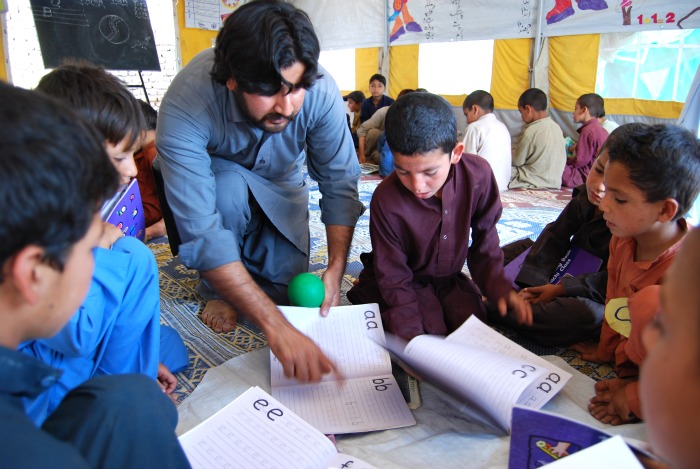
Students at the Jalozai refugee camp in Pakistan.

Students at the IRC-run school at the Jalozai refugee camp in Pakistan.

Recent headlines have teemed with news of the war against terrorism in Afghanistan, ethnic persecution in Chechnya, and civil unrest in Liberia. But in these places and others, huge numbers of refugees struggle to continue their children’s education despite the devastation.

By the start of 2002, an estimated 14.5 million people had fled their countries, and 20 more million were “displaced persons,” having abandoned their homes but remained within their nations’ borders. Relief organizations such as the New York City-based International Rescue Committee help by providing educational materials and teacher training.

The humanitarian-aid community increasingly recognizes that school is as important to refugee children as food and shelter, says Wendy Smith, a former teacher who oversees the IRC’s education programs. Her group, for one, has doubled the number of its initiatives in the past two years, expanding to 16 countries. The IRC’s 20 or so expatriate staffers—former teachers mostly from the United States and Europe—don’t head up classrooms, though. Instead, with the assistance of hundreds of local employees, they focus on “capacity building,” supporting community educators who want to reestablish schools.

Teacher Magazine talked with Smith—who spends much of her time on the road, visiting refugee communities from Kosovo to Kenya—about the challenges of teaching kids in regions torn apart.

Q. What are refugee camps like?

A. Refugee camps really vary based on the amount of support being provided by international and local institutions, the amount of time refugees have been in the camp—have they recently arrived, or, as in Afghanistan, have they been there for 20 years? Typically, if a camp is a new camp with people arriving on a daily basis, life is quite difficult. Multiple families or individuals might live under plastic, tentlike structures until sufficient sheeting and space has been organized for individual family housing. Displaced families seek shelter in abandoned factories, railroad cars, farms—literally anything you can think of.

Q. In a crisis situation, isn’t education a luxury?

A. No, not at all. A lot of people view education as a development activity, as something that’s only carried out in stable environments where there’s good governance. But in reality, education serves a really important psychosocial role in situations of crisis. If you look at a typical refugee population, half is children under the age of 18.

And what do children need? Children need to play. They need to be reassured. They need the opportunity to reestablish trusting relationships with adults.

Many of these children have been victims of violence themselves, or they’ve witnessed violent acts, and education provides the opportunity to pursue something that’s normal. You know, you get up in the morning, you put your backpack on your back, or you carry your stool to a temporary classroom under a tree. Their parents, in these situations, are often very occupied, whether it’s standing in food distribution lines or trying to build some sort of temporary shelter for their families. They don’t have the emotional resources to give to their kids that a school environment can provide.

And then there’s a protection component. If you look within refugee or displaced camps or communities that have been affected by crisis, unfortunately you see more and more children being recruited [into rebel armies]. You have kids as young as 8 years old being recruited into rebel forces in countries like Sierra Leone. Kids in a refugee camp with nothing to do, they’re ruminating and wondering, “What does life have to offer me anyway?” If we don’t take advantage of that kid’s time, I can tell you that a rebel force will. They’ll go to those children, and they’ll say, “I can offer you and your family riches beyond this mud,” and many of these kids get persuaded.

Q. Is providing education a new approach to dealing with refugee situations?

A. I’d say in the past five years, there’s been a real increased attention given to the role of education in conflicts, whether it be how education and schools contributed to conflicts—that can be certainly a part of it—as well as how education helps the psychosocial needs and protection needs of kids. If you go back in humanitarian history, it’s not that there were never education programs, but what it would typically be is: “Well, OK, we’ll get this community settled, we’ll make sure that there’s food, there’s shelter. Then maybe in a year or two, we’ll start an education program.” And the philosophy right now is very different. You don’t wait a year or two. You start right away, just as you are organizing food distribution lines; you start registration of children, you start recruiting teachers, you begin finding out who are the kids in this community.

Q. How does a relief organization like the IRC get an education program off the ground?

A. Every conflict seems to be different, [but] a lot of the times you’ll find that refugee populations or displaced populations have already started something on their own. They may not have tables and chairs and soccer balls and crayons, but they’re doing singing, clapping, dancing. When you enter a new situation, you find out who the teachers are in the community. Sometimes you have a lot of highly trained teachers who were displaced. Sometimes teachers were the fortunate ones who escaped and left their communities earlier. Or sometimes, teachers were the victims of violence—they were the ones who were targeted because they’re part of an intellectual elite—so you’ll find you don’t have many teachers left.

You usually start with nonformal education because there [may be] no books, and you’re not going to be able to get books for quite some time. So you bring teachers together and put together an ad hoc curriculum development group, and you just ask them to start writing what they remember. You take what you’ve got, and you move forward as quickly as possible.

Q. What’s it like for the local refugee teachers in the camps?

A. Everything is different for the teachers. They find themselves in situations where they have multiage classrooms. They may have a former child soldier in their classroom. They may have a pregnant girl sitting in the classroom, and that would have never happened before. It’s not the same as it used to be. That’s why teacher training is so important.

We try to work with teachers on child-friendly pedagogic practice—what does it mean to engage with children and ask them what they want, how are they feeling? Kids are not just extra baggage that show up in these refugee camps. They have ideas about what happened to them, on how to make the world better. Adolescents can positively contribute to what is essentially a reconstruction period after a conflict. The training the teachers are receiving—yeah, it’s different. But teachers around the world tend to be curious individuals, so I find them to be a pretty receptive audience.

Q. Do you find your job as a relief worker depressing?

A. It’s a humbling job. When you go to these communities, you see what people have been through, you listen to their stories, and you recognize in them this resilience, this hope for the future. I know of a couple of kids who actually graduated from our education programs in Guinea and who got scholarships to come study in the United States. Those are the exceptional ones, and maybe they’re not the ones who even should be referred to all the time, but you do have these amazing success stories, even if it’s not always permanent and might be taken away tomorrow.

Q. How can an American teacher grasp what it is like to be a refugee teacher?

A. I think September 11 really showed America that we’re part of the world. Having to respond to the events, having to explain it to their children, American teachers, for the first time, had a glimpse at what some of these refugee teachers experience.

Image by Ned Colt/IRC.

Is Now a Good Time to Start a Private Foundation?

(Crain’s Chicago Business, 25 January 2010)

Starting a private charitable foundation when you inherit a small fortune, sell a business or take your company public is one way to minimize taxes while doing good. Although the recession has made such windfalls less common, entrepreneurs are still finding reasons to get into the giving game.

Attorney Denis Pierce, 65, an owner of Pierce & Associates P.C. in Chicago, planned to start a family foundation two years ago with money from the sale of his interest in the law firm. When the sale fell through, he launched the foundation anyway, but with less funding.

The Pierce Family Charitable Foundation, which helps non-profits working on housing issues, started in December 2007 with $1 million. Thanks to Mr. Pierce, it now has about $3 million in assets and provides technological, fundraising and bookkeeping assistance to 10 organizations and gives operating funds to 10 more. “I’m moving into semi-retirement mode, and it gives me a whole other area to think about,” he says.

Interested in hanging out your own foundation shingle? Proceed cautiously. “A common misconception is that a family foundation is just like a checkbook,” says Melissa Berman, president of Rockefeller Philanthropy Advisors in New York, a non-profit that advises private clients and foundations. “In actuality, you’ve started a non-profit company, and you have to file a tax return and make sure your financials are in order.”

Foundations are required to donate at least 5% of their assets a year, and their investment earnings may be subject to excise tax. For these reasons, many experts suggest that starting with less than $1 million in assets is not worth it, unless you’re planning on pumping in significantly more money.

“Why would you want to start a new corporate entity and go through all of that math to give away less than $50,000 a year?” Ms. Berman says.

To run a foundation properly, you need plenty of legal and philanthropic advice. Laws governing non-profits are not always obvious, like the rules against self-dealing, which prohibit cousin Fred from renting his office space to the family foundation at a discount, even if it saves the foundation money.

Also, notes Valerie Lies, CEO of Donors Forum of Chicago, “people don’t understand how difficult it is to give money away thoughtfully. It requires a fair amount of due diligence. For any issue, there are hundreds of non-profits.”

The options for managing a foundation include hiring staff; dividing tasks among family members; paying a community foundation, bank or adviser to take care of administrative details, or opting for some combination of the three. All can be effective, but if grants account for less than 65% of annual expenses, your administrative costs are too high.

Philanthropists often start foundations with expectations that giving as a group will promote family unity. But that doesn’t happen without planning, especially in families not particularly harmonious to start with.

One way to avoid conflict is to find a focus agreeable to all family members, like protecting the environment, before writing the first check, even if that means giving up long-held plans to support stem-cell research (it upsets sister Linda) or scholarships to Notre Dame (one son-in-law went to Michigan).

It’s also essential to define who has the power in the venture. “If dad established the foundation, is it the adult children’s role to support dad?” says Virginia Esposito, president of the National Center for Family Philanthropy in Washington, D.C. “Well, sometimes dad’s hoping that other people will take a lot of the initiative.”

“The best way to do a good job is to have trustees who can give the work the time it takes,” Ms. Espo-sito says. Be honest about how much time each person can devote. Let offspring with children or demanding careers step away if they must.

“Say to your daughter who’s an intern at a hospital, ‘We understand you don’t have time now, and we’ll welcome you back later,’ ” Ms. Esposito says. “It’s much better than making her feel she’s letting the family down because she can’t come to board meetings.”

©2010 by Crain Communications Inc.

Read this article at Crain’s Chicago Business.

A Revolution on the Stage

usnews-ancient(U.S. News & World Report, Special Edition on the Ancient World, 2004)

When Lysistrata premiered in Athens over 2,000 years ago, it played to an audience of about 15,000 assembled on a hill behind the Acropolis. Last March, Aristophanes’s famous comedy was performed in decidedly humbler circumstances—in living rooms, cafes, and even a Kurdish refugee settlement in Greece.

The play, about women who withhold sex to force their men to end the Peloponnesian War, was revived by two New York actresses to protest the Iraq war. In a single 24-hour period, the play was performed by tens of thousands of people in 59 countries. Although some productions strayed far from the original, participants said there remained enormous potency in Lysistrata’s core issues—questions like: What power do the powerless have? “It was like a rock concert,” says project cofounder Kathryn Blume, “in terms of the energy and the outpouring of enthusiasm.

No modern play would have served the activists’ purposes better, Blume says. “[Lysistrata] is sexy, it’s funny, it’s dirty, [and] it really reflected our situation—a group of people who feel they don’t have a voice, undertaking a creative action to stop a war.” And because Lysistrata is such an ancient play, Blume notes, it distances the audience from the specifics, freeing them to ponder the broader themes.

It doesn’t take a protest, however, to get Greek drama an audience these days. In recent years, theatergoers have flocked to see A-list actresses like Diana Rigg and Fiona Shaw interpret the title character in Medea. They have had their senses assaulted at Lee Brauer’s The Gospel at Colonus, a version of Oedipus at Colonus set at an African-American church revival. And they have applauded Peter Sellars’s The Children of Herakles, in which a silent chorus of real refugee children underscored the play’s discussion of exile. In fact, according to researchers at the University of Oxford, more Greek tragedy has been performed in the past 30 years than at any other time since the classical age itself.

Why the enduring appeal? Greek tragedies explore how difficult it is to be a human being. Most Greek tragedy portrays the downfall of a hero, often caused by extreme arrogance, or hubris. Tragedy’s goal, said Aristotle, is to arouse in the audience feelings of pity and fear, emotions that are then purged in a process of relief the Greeks called katharsis. Tragedies have a particular appeal, says Nicholas Rudall, a classics professor at the University of Chicago, “in times when people don’t feel fully confident about their being, their safety.” Edith Hall, codirector of the Archive of Performances of Greek and Roman Drama, says that Greek plays also allow modern audiences to explore a fascination with survivors.

In the moralistic tragedies of later centuries, playwrights tended to kill off characters who committed adultery, murder, or rape, writes Hall in Dionysus Since 69: Greek Tragedy at the Dawn of the Third Millennium. Not the Greeks. “The incestuous Oedipus, the infanticidal Heracles, Medea, and Agave, the mother-murdering Orestes, the bereaved women of Troy—they all survive their terrible experiences and stagger from the stage, leaving the audience wondering how they can possibly cope with their psychological burdens.”

Greek drama has influenced writers from Shakespeare to sitcom hacks. Yet it’s remarkable that there are any ancient plays left to learn from at all, since they were written on rolls of papyrus that rotted easily. Of the more than 1,000 plays created in Athens between 500 B.C. and 400 B.C., only 31 tragedies and 11 comedies—the work of just four authors—survive.

Most scholars believe that Greek drama evolved from hymns about popular myths that were performed at the annual festivals of Dionysus, the Greek god of wine and fertility. One day in the mid-sixth century, the story goes, a man named Thespis stepped out of the chorus to converse with the rest of the group, In so doing, he became the world’s first actor, and he created a new art form—the tragedy.

In 534, Athens introduced an annual tragedy contest at the City Dionysia. Every year, an official chose three dramatists to present an entire day of new plays—three tragedies and a satyr play, a comic chaser to the serious work. The playwrights directed (and early on, acted in) their own works. The city assigned a wealthy citizen to pay for all production costs not covered by the state. Foreshadowing Oscar-night pools by centuries, a panel of ordinary citizens, chosen by lottery, judged the plays and awarded prizes.

Among the festivals’ most important innovators were the three tragedians whose work has survived. Aeschylus (523 – 456) pulled a second actor out of the chorus to more fully develop dramatic confrontations. In works such as the Oresteia trilogy, he used personal stories to explore political concepts like justice. Sophocles (circa 496 – 406) focused on his protagonists’ psychological development in masterly structured plays like Oedipus Rex, Oedipus at Colonus, and Antigone. He introduced a third actor, painted scenery, and reduced the chorus from 50 to 15.

It was Euripides, however, who pushed the envelope of civil discourse. In plays like Medea, Electra, and the The Trojan Women, he took on incest, infanticide, and more. His plots can seem half-baked—many depend on a deus ex machina, or sudden appearance of a god character, to neatly untangle events—but they have provided generations of actors with complex female characters to inhabit.

Around 488, the City Dionysia added a comedy competition to the lineup. Many scholars believe ancient Greek comedy grew out of a feature of early Dionysian festivals called the komos—a bawdy parade of jokesters who carried symbols of penises through the streets. The 11 plays from Aristophanes (circa 448 – 395) are marked by obscene lines, double-entendres, and coarse costumes, including erect phalluses worn by sexually frustrated male characters in Lysistrata. While never considered as lofty a genre as tragedy, comedy helped diffuse anxieties by satirizing important people and institutions through characters that solved social or political problems with absurd schemes.

Most contemporary producers aim to make the Greek classics as accessible as possible to audiences by using modern language, current fashions, and familiar locales. But archaeological finds, from painted vases to ruins of outdoor theaters, provide tantalizing clues to the ancient performances, and a few modern companies are presenting the old plays to conform with these ideas. Classic Greek Theater of Oregon, for example, performs in an outdoor ampitheater. The actors wear masks and tunics copied from vase paintings, and large choruses sing and dance to original music.

At New York University’s Aquila Theatre Company, producing artistic director Peter Meineck also strives to capture the atmosphere of the ancient performances, which he calls “a cross between an opera and a football game.” The actors may perform without masks, but they often use them in rehearsal. “It’s a completely different way of performance,” he says. “The actors, when they speak, all have to face the front; they can’t turn and face each other. Often an actor is standing behind another actor speaking out to the audience, and what that creates on stage is very interesting psychologically. Naturalism, which is what most actors are trained to do, is out the window.”

In spite of the challenges, Meineck says, when a Greek play hits a nerve, he knows it. In the mid-1990s, the Aquila presented The Wasps, Aristophanes’s comedy about a litigation-crazed society. It was a rowdy production that one reviewer likened to a Benny Hill skit. The performance coincided with “a time when people were really getting fed up with their legal system,” Meineck says. “It tapped into this aggressive energy that was in the audience, and it was an amazing rush. At the end, we had the entire audience up on stage—dancing.”

Tailgate [teyl-geht]

(Food Network Magazine, Fall 2006)

On a typical fall Saturday when the Pennsylvania State University football team is playing at home, 80,000 fans will come to tailgate: eating and hanging out near their vehicles in the parking lot before the game. Most will bring gas or charcoal grills. For last year’s alumni weekend game, restaurant owner Scott Snider and deli owner Ken Bond also brought sand.

The friends needed it for the Hawaiian-luau-themed retreat they created around their R.V. They assembled a faux beach and a pool and served tropical blue cocktails to reflect the team colors, blue and white. At other games, the two have set up a mini-discotheque with a floor that lights up, carted in a propane-heated hot tub, and made a blue and white meal featuring hotdogs and bread dyed blue.

This new breed of pre-game picnicker arrives three to four hours before the event in cars painted in team colors and unpacks stereos and sometimes karaoke machines along with full-size grills. After the game, they post photos and recipes to their tailgating Web sites.

It’s no wonder 40 percent of tailgaters never even make it out of the parking lot, according to John Largent, president of the San Antonio-based American Tailgaters Association (ATA). Watching the day’s event on the big-screen TV they brought can be just as much fun.

Thirty-six million people tailgated at least once in 2005, according to the ATA. About half of these tailgated six to 10 times that year. Football games and NASCAR races draw most tailgaters, though fans also feast at horseracing tracks and before concerts. Even the Santa Fe Opera’s parking lot hosts diners before performances—many wearing black-tie, of course.

Tailgaters’ numbers are increasing as fans of more sports, like professional lacrosse and high school football, make eating in the parking lot their pre-game ritual, too. Most pro leagues and colleges promote tailgating, often by sponsoring cook-off contests, because it generates team loyalty. One exception is major league baseball; its food vendors’ rights to sell hotdogs extend out into the parking lots, and they discourage fans from bringing their own.

Curiously, there was tailgating before there were tailgates. In the mid-1800s, cooks dished out stew from the backs of chuckwagons to cowboys on the cattle trails. Students ate next to their horse-and-buggies before the first college football game, between Rutgers and Princeton, in 1869. When the Ford Motor Co. introduced the 1927 Model A Station Wagon, sports fans used its fold-down tailgate, the first of its kind, as a table and attached the name to their pre-game picnicking. Now, vehicles come with “tailgating features,” such as electrical outlets at the back.

What’s usually on the menu? It depends on where you park your truck. Regional cuisine shares cooler space with the ever-popular burgers and bratwurst, so you’ll find swordfish in California, bison in Montana, and gumbo in Louisiana.

With such ambitious food, it takes a well-oiled operation to be a 21st-century tailgater. Tim Gill, general manager of Stocker Chevrolet in State College, Pa., and his wife have cooked creative meals before Penn State football games for almost eight years, ranging from lobster to grouper and deep-fried turkeys for a game close to Thanksgiving. Once they brought a chocolate fountain.

“We have it down to a science,” says Mr. Gill. The Gills have a van they use only for tailgating in which they store their two grills, along with other necessities like a 10-by-18-foot canopy and tables. They pick a menu on Monday, shop for food on Wednesday, get more food delivered to Mr. Gill’s workplace on Friday (his boss started their 20- to 100-person tailgating group), and load the food into the van on Friday night. For a 3:30 p.m. kick-off time, they roll into the parking lot at 9 a.m. on Saturday. They wash the dishes on Sunday.

So what makes all the work worth it? “We’ve lost a lot of our socializing opportunities in America,” says ATA’s John Largent. “We used to have more church socials. We used to have less to do. The appeal of tailgating is that it is that last place where you can gather with your friends, coworkers, and college buddies, and reconnect.”

Speeding Up to Relax

(The Wall Street Journal, 18 June 2001)

There’s the man who runs Precision Fire Protection Inc., a 25-person company in Reinholds, Pa., that designs and installs automatic sprinkler systems. Then there’s the man who straps himself into his souped-up Porsche on weekends and whips around a racetrack at 120 miles an hour.

Mr. Miller races in regional events for the Porsche Club of America, a Springfield, Va., organization that isn’t affiliated with the car maker, about 12 times a year at tracks up and down the East Coast, including venues where professionals race, like Watkins Glen International in upstate New York.

The 49-year-old is one of thousands of small-business owners who aren’t content to gaze lovingly at their hard-earned sports car in the driveway. These car owners have simply got to see how fast they can make that baby go, says Billy Edwards, chief driving instructor at Track Time Inc., a Youngstown, Ohio, driving school.

On the street, “you can’t drive a Porsche or a Corvette the way it was meant to be driven,” says Mr. Edwards. “We get guys here who realize, ‘I have this $85,000 car and I’ve never gone over 100 miles per hour in it.’ ”

Mr. Edwards says enrollment in the school’s sports-car performance-driving division has grown 17% to 1,020 since 1999, which he attributes to the growing popularity of Nascar racing. And it’s not just men trying to live out their racing dreams: 30% of his school’s students are women.

As for Mr. Miller, he first put his pedal to the metal about 10 years ago at the Bertil Roos Racing School in Blakeslee, Pa. He and a group of 15 friends, most of whom also own their own businesses, signed up for a weekend course, driving cars provided by the school. “We had a blast,” he recalls. “We ran off the track. We ran into each other. Then we went to dinner with our wives and laughed about it. They thought we were just crazy.”

After that, Mr. Miller was hooked. He went on to complete an eight-session course by the Porsche Club of America designed to prepare him for racing in club competitions. The club has strict rules to keep its members safe and the competition friendly: If a driver makes contact with other cars twice in 13 months, he or she is barred from the series for more than a year. “Our series doesn’t condone running into anyone to pass,” Mr. Miller notes.

There’s no prize money, though. That’s unfortunate for Mr. Miller, who won 10 out of the 12 national races he entered in 2000.

And racing isn’t cheap. In addition to the care of their sports cars and fuel, drivers shell out a couple hundred dollars for a day’s worth of instruction to a couple thousand dollars for a weekend course. Racing in a weekend competition can cost upward of $1,000, not including travel costs and wear and tear on the car. To save money, many racers do their own maintenance, which can be time-consuming. Mr. Miller estimates he spends 40 hours in the month before a race getting his car ready.

But for work-obsessed entrepreneurs, it can be worth it. Racing “is a release,” Mr. Miller says. “When I’m racing, I don’t think about the business at all.”

Show and Tell

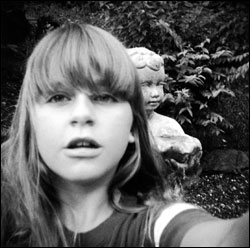
"I took a picture of myself with the statue in the back yard" by Janet Stallard, Kentucky

I took a picture of myself with the statue in the back yard  — Janet Stallard, Kentucky

(Teacher Magazine, October 2001)

Durham, N.C. — There’s a photograph in “Secret Games,” the retrospective of Wendy Ewald’s work currently on exhibit at the Addison Gallery of American Art in Andover, Mass., that shows a skinny boy floating in space. Actually, he’s not floating. The boy, who’s black, is perched on a window ledge with his arms wrapped around his waist. The window is bathed in squintingly bright light, and the contrast between the washed-out background and the darker figure makes it look like the boy is levitating. The left half of the photo is draped in shadow, which gives the picture an ominous tone—the boy, in his cold, white space, has been abandoned, or perhaps singled out under a spotlight. He gazes stoically into the distance, enduring his isolation.

Ewald did not take the boy’s picture. She didn’t conceive of the scene, pose the youth, or develop the print. Phillip Liverpool, a 4th grader at a public school in Durham, N.C., did all the work. He planned the picture and focused his camera using a stand-in, then switched places and signaled his assistant to shoot. Phillip had the highest IQ in his school, Ewald says, but he often landed in trouble because he couldn’t concentrate and struggled to finish assignments. The photo is a self-portrait, which he titled “I am alone in the wilderness.”

Ewald may not have shot the photograph herself, but she did create the conditions that enabled Phillip to tell his story. He is one of hundreds of people around the world—mostly children, but also members of other frequently voiceless groups, such as Saudi Arabian women—whom Ewald has taught to use cameras to document their lives.

“It’s to help them develop a sense of self-confidence,” the 50-year-old explains. “When kids make pictures of things, they give value to those things.”

“It’s about power,” Leon McDermott, an art critic in Edinburgh, Scotland, writes in a rave review of Ewald’s show, which recently toured Europe before reaching the United States. “Maybe for the first time, Ewald’s collaborators have power of their own.”

Ewald, who has been producing pieces with her students for 30 years, never tells anyone exactly how to create an image. Instead, she asks questions designed to facilitate her collaborators’ self-expression. Early on, she considered her students’ photos as separate from her own; then she recognized how intertwined the works actually were. “At a certain point, I realized that all of this was what I did,” she says. “It’s not, ‘This is me as an artist, and this is me as a teacher.’ Both of those things come out of the same spirit, and are both art and education.”

The steps involved in Ewald’s art-making process, which she has officially titled “Literacy Through Photography,” or LTP, are straightforward. Typically, supported by grant money, she moves into a community for several months or longer, teaches her collaborators how to use cameras—mostly 35mm, with fixed-focus lenses—and shows them how to develop and print film. Then she guides participants through a series of assignments that hit close to home: “self-portrait,” “family,” “community,” and “dreams.” Before shooting the photos, students write about each theme. Afterward, they pen pieces about what their images reveal.

As simple as the process sounds, the results are striking and, in the case of children’s photos especially, surprisingly sophisticated. McDermott, in his review, calls the work “photography at its most honest.” The images, he writes, are “the minds of children captured on celluloid, and they’re as strange and twisted and funny and sad as you could imagine.”

In his 1997 book Doing Documentary Work, the psychiatrist Robert Coles discusses the difficulties inherent in keeping personal biases out of documentaries. He calls Ewald’s methods “brilliantly ingenious” for sidestepping the problem by putting the documentary camera into subjects’ own hands.

Ten years ago, Ewald began training public school teachers in Durham to use her process in their classrooms. I Wanna Take Me a Picture: Teaching Photography and Writing to Children, a book based in part on that experience, will be published later this fall. It’s a how-to manual Ewald hopes will be read, and used, by educators everywhere.

Ewald’s plan—to spread the LTP gospel—is ambitious. What artist has ever managed to reproduce his or her method in a school setting, where funds as well as time tend to be scarce, and art is usually the lowest of priorities? Further complicating matters, Ewald’s collaborations often contain violent and provocative imagery—the stuff of the intimate moments she encourages kids to represent. It’s not the sort of artwork teachers are accustomed to hanging on their walls. Nevertheless, many educators say, Ewald has transformed the way they look at photography and at their students’ lives.

ON A MONDAY afternoon in mid-June, the photographer is watching a roomful of teachers and other adults, all of whom have their hands deep inside nylon bags. The group is this year’s cohort for the “Introduction to Literacy Through Photography” workshop, which Ewald and her assistants conduct every summer in Durham. The 22 participants, 12 of them teachers from the local district, are learning how to transfer rolls of film from their cameras onto plastic reels without exposing them to light—hence, the bags. Most darkrooms are not large enough to accommodate the 30 or so kids who usually make up a class, so knowing how to safely transfer film outside of a darkroom will save these future instructors time.

LTP project coordinator Dwayne Dixon, a 29-year-old with a chunky metal chain looping from belt to pocket, leads the exercise, which requires participants first to pry the top off a film canister using a bottle opener inside the bag. “This might take a while for some of your students,” he says as a good number of the adults struggle. “They’re not as adept at opening beer bottles as they would have you believe.”

“One-hour photo—how do they do it?” giggles Susan Ward, an English-as-a-second-language teacher at Burton Elementary School. “This is more like one-week photo!”

Ewald, wearing layers of rumpled linen and looking youthful despite gray-flecked hair, sits quietly in the back of the classroom. She’ll spend much of the week there, on the outskirts. When the participants work their way through writing exercises, she’ll mingle wordlessly among them, dispensing encouraging smiles and looking over their shoulders with intense interest. Her behavior around children is evidently similar. “She talks to them like they’re her peers,” says Dixon, “like they’re completely capable, [and] challenges them to arrive at solutions on their own. She’s willing to sit there and act as a foil and talk it out. But she’s not going to pop out this little fortune-cookie answer for them.”

Despite Ewald’s light touch, she is a forceful presence. She’ll patiently follow a conversation, then jump in at a key point to illuminate an idea or help untangle a thought. Meanwhile, Dixon and Katie Hyde, another LTP coordinator, drive the workshop along, introducing discussions, explaining assignments, and announcing the arrival of politically correct lunches like vegetarian soul food.

Ewald also tells fabulous stories. She once conducted a workshop in apartheid-era South Africa, where she worked with both black and white students. “The ‘community’ pictures the [white] Afrikaner children took were chilling,” she recalls. “One girl took a picture of ‘what I don’t like about where I live,’ and it’s a black man standing behind a fence with some shopping bags. The photo’s blurry”—as though the child couldn’t bear to look at the man. “It was like a visual representation of the psychological damage of racism,” Ewald says.

As Ewald shares her anecdotes, Jaime Permuth, a photographer based in New York City, scribbles happily in his notebook. This is exactly why he’s here. An outgoing 33-year-old Guatemalan, he’s a member of the group of non-teachers who usually participate in the LTP workshops. This past summer, 10 out-of-towners, including photographers and museum employees from places as far-flung as Hong Kong, have paid $400 each to sit at Ewald’s feet. Two of them literally shake with emotion as they describe the effect her work has had on them. On the other hand, the teachers—whose participation has been sponsored by the school system—barely know who Ewald is.

Laura Batt, for instance, is a 22-year-old Teach For America graduate who just wrapped up her first year of teaching math at Githens Middle School. She’s hungry for curriculum ideas—this is her fifth professional-development workshop this year— and she signed up for Ewald’s course because she thought that incorporating photography into her classes would be “neat.”

Whatever the participants’ backgrounds, Ewald has designed the five-day workshop so they know what it’s like to be a kid working on an LTP project, albeit at an accelerated pace. These instructors have to learn in one week what most will, in turn, teach to their students over the course of a semester. This morning, after distributing cameras, Ewald discussed “reading” a photograph—studying the content, the contrast between light and dark, and other elements to understand what an artist is trying to communicate. Later today, the group will split up and shoot the first assignment, “self-portrait,” solo, then write an accompanying narrative.

The rest of the week will follow a similar rhythm, with the group meeting at the Center for Documentary Studies, an old, white-shingled house with oversize rocking chairs on the front porch that is Ewald’s base in Durham. For a few hours each day, the participants will write about and discuss ideas for assignments they’ll shoot that evening; they’ll also develop negatives in the center’s darkroom and in public schools around town. Batt is tickled when she learns she’s been assigned to the Githens darkroom—she didn’t even know her school had one.

Late in the week, the participants spread their “community” photos on the floor for a group analysis. Permuth, the New York photographer, evidently had asked passersby to snap shots of him: He’s seen wearing an employee’s hat at Kinko’s, posing with a spatula next to a grill in a restaurant kitchen, and pumping gas at a station. His photos draw plenty of laughs. Meanwhile, the group pays less attention to the pictures taken by Marva Peace, an African-American teacher at R.N. Harris Elementary who’s been pretty quiet all week. But Ewald’s eyes lock onto the series, which, at first glance, looks pretty mundane—images of suburban houses, shot from a distance, through the rain, with not a person in sight. “Tell me about these,” Ewald says.

“Well, I guess it’s like a sequence of my life,” Peace explains. “They’re houses I lived in, growing up around Durham.”

“Do you go back and visit? Do you still know people in these neighborhoods?”

“Not really. All of these are just places I remember.”

“This is what’s amazing,” Ewald says. “You can tell the photographer feels disconnected from this community, that she almost feels hesitant to be there. Here, you can see she didn’t even get out of the car to take the photo. And it’s just wonderful that her vehicle’s in the picture because it’s a trip back in time.”

The idea that you don’t have to be a professional—or even an adult—to take powerful photographs is key to Ewald’s work. Says Philip Brookman, a curator at the Corcoran Gallery in Washington, which will exhibit “Secret Games” early next year: “Art is usually taught as something that’s very separate from people’s everyday lives and something that takes a technical mastery before you can really be an artist. What Wendy teaches is … that’s not true.”

The assignments Ewald has devised also tend to flatten classroom hierarchies, both academic and social. Alan B. Teasley, a Durham administrator who has used the LTP method in the past, compares the program to a typical beginning-of-the-year assignment. “[If] you have them write on ‘My Summer Vacation’—well, some kids hung around home all the time, some kids went to Disney World. The Disney World kids have more to say.” Or so it would seem. But with Ewald’s work, he adds, students learn how to write about, then interpret with images, the everyday— their lives, communities, and dreams included. “Every kid has that.”

NOT MUCH older than a kid herself, Ewald began her career in the summer of 1970, when she was just 18. The daughter of a prizefight manager, she left her hometown of Detroit that summer for a job with Native American children in Labrador, Newfoundland. Ewald had been a budding photojournalist since she got her first camera at 11, and she wanted to share her passion with other kids. So she organized a photography class using 10 cameras and 100 film packs donated by the Polaroid Foundation. She also intended to document the desperate conditions on the Indian reservation with her own pictures. But she quickly became frustrated. Her shots, she felt, often were compromised by her desire not to be intrusive or exploitative.

One day, she and a local boy, a 14-year-old named Merton, decided to photograph the reservation’s graveyard. The results were telling. “My image shows what a Native American graveyard looks like. You can read the inscription on the gravestone and see the simple handmade crosses in the background,” writes Ewald in Secret Games, the companion book to her retrospective exhibit. “Merton’s picture doesn’t do that. It is grainy, washed-out, and the proportions are ‘wrong.’ But his cemetery is a frightening place. No one goes there—or if they do, they often see ghosts.”

That afternoon was a watershed in Ewald’s life—the moment she realized that people who belong to a community always will portray their experiences more accurately and expressively than a visitor does. So she decided to document people’s lives in a new way, by assisting and empowering community photographers, particularly children, to reveal themselves. In the years since, her mission has taken her to rural America and six other countries: Canada, Colombia, India, Mexico, Morocco, and South Africa.

In 1989, the itinerant photographer was invited by the Center for Documentary Studies, a Duke University affiliate, to work as a visiting artist in three public schools. Two years later, she also started teaching a course on photography in Duke’s education department. By that time, her expertise was being sought by more schools than she could handle. So she came up with a way to lighten her load: requiring her college students to work as photography interns in local schools.

ALTHOUGH EWALD’S efforts generally have been well-received, some find the Literacy Through Photography images too unsettling. A few Durham principals have refused to let classes exhibit the work in public venues, fearing that those not acquainted with the program would misinterpret the photos. There’s the “weirdness” factor, too, the disturbing scenes that may be a natural outgrowth of assignments like “dreams,” which include scenes from kids’ nightmares. Ewald’s collaborators have produced pictures titled “I killed my best friend, Ricky Dixon,” “I am the girl with the snake around her neck,” and “I am dead.”

“The ‘creepy’ question? Oh, we get that all the time,” says Ewald. But the photos, say many LTP educators, simply reflect children’s realities. As Ewald notes, the pictures show that “kids do have complicated lives.”

Nobody encourages the amateur photographers to be gloomy or gory in their work. “We don’t show kids other kids’ pictures before we start,” Dixon says. “We show them what can be possible, like what does framing do? What does placement of the camera do?”

Do such personal images have a place in the classroom? “I’m not bothered by it,” says Teasley, the Durham Public Schools’ executive director for grants administration. “I know some English teachers who gave up on having kids do journals because they would find out about things that they would then either have to act on or ignore, and they didn’t want to do that. They didn’t want to be engaged with their teenagers’ reproductive lives, for example. And I say that’s great—don’t ask for it, if that’s not what you want.”

Whatever the reactions, Ewald is happy her process has found a home in Durham, where 14 schools now conduct LTP projects. She divides her time between that city and the house she shares with her husband and 6-year-old son in upstate New York. Eventually, she’d like to see LTP in school systems worldwide. Ewald shrugs off any suggestions that schools, with their tight schedules and set curricula, inhibit creativity. “You just need to find teachers who are open to who their students are, flexible in developing ways of carrying out projects, and willing to learn from what their students are doing. Oh, and organized,” she says. “There is a lot of work to do.”

Part of the work involves figuring out how to integrate photography into curricula. On the third day of the summer seminar, two teachers who have already put Literacy Through Photography into practice stop by for a little show-and-tell. Denise Friesen, a 4th and 5th grade teacher, and Katja Van Brabant-Stevens, a language arts teacher, have brought examples to the workshop.

Friesen relates how she’s used LTP to teach math concepts. “Go find symmetry in nature and photograph it,” she’s told her students. Van Brabant-Stevens stresses the necessity of helping kids plan ahead. Sticking to the LTP method, she doesn’t tell students what and how to shoot. But she does ask lots of questions, such as: “What 12 pictures would you take if you wanted to explain who you were? What about the camera angles? Where are you going to be when you take the photo?” If you don’t guide the students, she cautions, “you’re going to get a whole lot of pictures in the cafeteria of their friends, with their heads cut off.”

KIDS ARE not the only ones who learn from LTP. Friesen says the program has helped her understand and, thus, support her students: “You really get an intimate look into the lives of children. You see what the inside of their houses are like, and maybe you see a poster on the wall and you [say], ‘Oh, you like that?’ What I learn about them really drives my instruction.” In fact, if she notices in the photos that a student has taken a particular interest in, say, dogs, she might call on that kid as an expert when the subject comes up in class. “It really builds their self-esteem, so they’re able to cooperate and maybe be a little more engaged in school,” Friesen explains.

Inevitably, the question of assessment arises. “Did you see writing and test scores go up?” one workshop participant asks. LTP does make students more comfortable with the writing process, Van Brabant-Stevens says. But, she adds: “I never sell LTP in terms of test scores or student achievement, partly because I don’t think that’s why students are in school.”

In fact, Ewald never set out to improve academic skills. For her, the “literacy” part of LTP is a reference to the students’ ability to interpret the world. But leaders of the 30,000-student Durham district, who have to keep an eye on the bottom line, would like to be able to measure LTP’s academic effects, and Teasley is seeking funding for a study.

By late August, six weeks after the LTP workshop ended, it’s clear that Permuth, whose livelihood derives in part from visiting-artist gigs at K-12 schools, has taken Ewald’s teachings to heart. He’s already led his first LTP- type project. “I really wanted to do something soon. I didn’t want to let it sit there for months,” he says. “I was inspired by Wendy, and I wanted to see what would happen and how it would change my experience as an artist-educator to use her methods.”

Batt, however, has yet to find a way to work LTP into her schedule. At the start of the school year, her head is bursting with new lesson plans and students, so she’s proceeding more cautiously, trying to work out a way to start a project next semester. She’s even talked to a social studies teacher about teaming up, so as to expose their students to twice the amount of LTP time.

Despite the logistical obstacles, Batt is determined, and she’ll get ample help from Ewald’s crew. Hyde, for example, recently phoned Batt to ask her if she needed a university intern for the semester. Batt jokes that there is a cultlike aspect to LTP. “At the end of the workshop,” she says, “there was this sense of expectation that you will do this.”

In I Wanna Take Me a Picture, Ewald notes that all people feel a need “to articulate and communicate something relevant about our personal and communal lives.” Interestingly, the projects she’s designed to help children have injected pride and energy into another underappreciated group: educators.

Durham art teacher Robert Hunter, who’s worked on LTP projects since the early 1990s, has helped design a race-relations curriculum that will be used for the first time in several schools this fall. “Wendy was the catalyst,” he says. “I no longer just see myself as ‘that Shepard [Middle School] art teacher.’ I see myself as a facilitator and an educator for a community.” Teasley recalls that he was working for the Durham school system in 1994 when Ewald asked a group of middle school students to imagine what it would be like to be a member of a different race. Each kid wrote about his or her “black self” and “white self” before posing for Ewald.

The students then scratched or wrote on the images to further express their visions. The portraits are extraordinarily candid, especially considering what was going on in Durham at the time. Two years earlier, the state had forced mostly white suburban schools to merge with mostly black city schools. The results were revealing. Many of the white kids wrote in superficial ways about being black— “I would like shows like ‘Martin,’ ” for instance—and some of the African- American students heartbreakingly described their white selves as being “nicer” or “smarter.”

When the Corcoran Gallery decided to exhibit Black Self/White Self in 1997, Teasley was so excited that he drove to Washington for the opening. “I [simply] felt such tremendous pride that my school district would host a project like that. I kept wanting to go, ‘Hey, I live there!’ ”

Walking among the images, he came across a Durham student who had probably never heard of the Corcoran, let alone imagined his art would be displayed in such a gallery in the heart of the nation’s capital. Teasley asked him if he was one of the artists. “Yeah, that’s my photograph,” the boy said with pride.

“That’s one of those goose- bump moments that you just can’t purchase,” Teasley says today. “And I’m really grateful to Wendy for providing that for our kids, but also providing it for me.”

Read this article at Education Week.

Image: From Wendy Ewald’s collaborative works with children project in Kentucky (c) 2000 Appalshop